
Introduction
A few years ago, organizations were asking a simple question: Should we move to the cloud?
Today, the question has changed: How can we use Artificial Intelligence?
Across industries, AI has become one of the most talked-about technologies in boardrooms. Leadership teams are discussing how it can improve productivity, automate repetitive tasks, accelerate decision-making, enhance customer experiences, and create competitive advantages. Every conference, strategy meeting, and technology roadmap seems to include a conversation about AI.
And understandably so. The promise of AI is difficult to ignore. Employees can generate reports within minutes, summarize lengthy documents instantly, assist with software development, automate administrative tasks, and create content at a scale that was previously unimaginable. Organizations see an opportunity to move faster, operate more efficiently, and remain competitive in an increasingly digital world.
However, while executives are actively discussing how AI can transform their businesses, a far more important conversation is often missing. Who is governing it? That question is emerging as one of the most significant cybersecurity and governance challenges organizations face today.
The AI Adoption Boom Is Already Here
One of the most common misconceptions about artificial intelligence is that organizations are still "planning" for it. Whereas, in reality, AI adoption has already begun.
The marketing team experimenting with content generation tools. The developer relying on AI code assistants. The HR department using AI-powered recruitment solutions. The finance professional leveraging AI for analysis and reporting. The legal team exploring AI-based contract reviews. In many organizations, these activities are happening every day.
The interesting part is that most of this adoption is not being driven by formal technology programs. Employees are discovering AI tools on their own because the benefits are immediate and obvious. Unlike large technology projects that require months of planning, many AI platforms can be accessed within minutes.
And that is precisely where the challenge begins. By the time leadership teams begin discussing AI governance, employees may have already integrated dozens of AI tools into their daily workflows.
When Innovation Moves Faster Than Governance
Technology has always evolved faster than policy.
Organizations experienced this during the rise of mobile devices, cloud storage, and collaboration platforms. Employees adopted useful tools long before governance frameworks were ready to manage them. Eventually, this phenomenon became known as Shadow IT.
Artificial Intelligence is following the same pattern, but at a much greater speed. The difference is that most employees do not see AI as a technology platform. They see it as a productivity tool.
To an employee, uploading a report to an AI application might feel no different from using a spreadsheet. Asking an AI assistant to summarize meeting notes may appear no different from searching for information online. It feels convenient, efficient, and harmless.
What often gets overlooked is that AI is not merely storing information. It is processing it, analyzing it, generating outputs from it, and in some cases learning from it.
That changes the risk equation entirely.
As adoption accelerates, organizations are finding themselves in a situation where AI usage is increasing much faster than governance mechanisms can keep pace.
The Boardroom Conversation That Isn't Happening
In many boardrooms, discussions around AI are understandably focused on opportunity. Leadership teams want to understand how AI can reduce costs, improve productivity, automate repetitive activities, and create competitive advantages. These are important conversations because they directly impact business growth and operational efficiency.
However, a different set of questions receives far less attention. Organizations rarely spend the same amount of time discussing which AI tools employees are already using, whether those tools have been reviewed, what information is being shared with them, and who remains accountable if an AI-driven decision goes wrong. The absence of these conversations is often where the governance challenge begins.
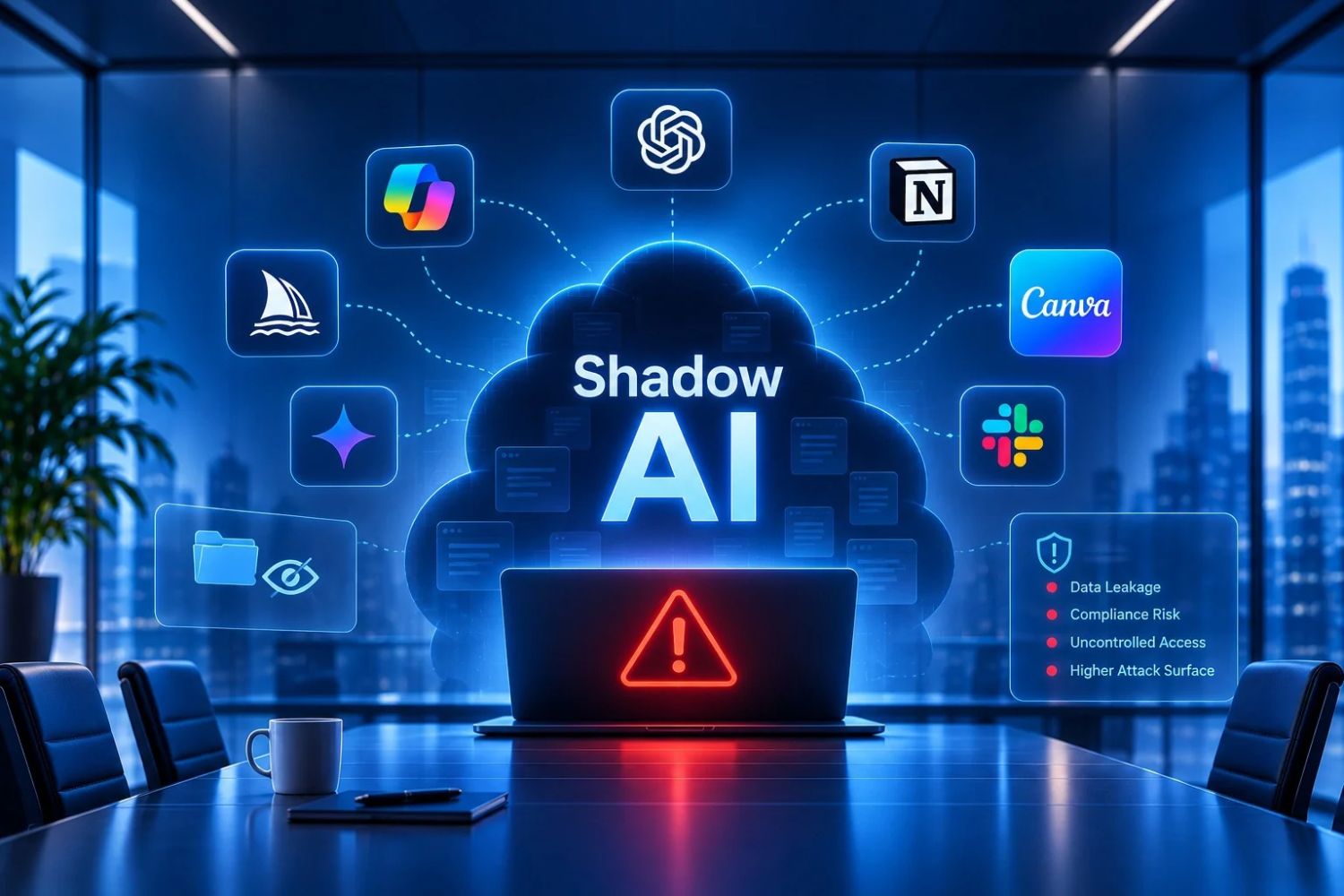
For many organizations, there are no clear answers. This is not because leadership is ignoring the issue. It is because the speed of AI adoption has created a governance gap. Organizations are focusing heavily on what AI can do while spending much less time discussing how it should be governed. And that governance gap is where Shadow AI begins to emerge.
The Risk Often Doesn't Look Like a Risk
One reason Shadow AI has become so difficult to identify is because it rarely looks dangerous. There is no ransomware alert, No malware infection, No suspicious email, No obvious security incident.
Instead, the risk often begins with a perfectly reasonable business activity. An employee wants to summarize a report more quickly, A manager wants assistance creating a presentation, A developer wants to debug software code, A salesperson wants help drafting customer communications.
Each individual decision appears harmless. In fact, each may improve productivity. But when thousands of employees across an organization make similar decisions every day, sensitive business information may gradually begin flowing into systems that were never reviewed by cybersecurity, privacy, legal, or compliance teams.
The danger is not necessarily malicious intent; the danger is invisibility. Organizations cannot govern what they cannot see.
Why Cybersecurity Teams Are Paying Attention
For years, cybersecurity professionals focused primarily on protecting networks, applications, devices, and infrastructure. AI introduces a very different challenge.
Unlike traditional cyber risks that attempt to enter an organization from the outside, Shadow AI often grows from within. Employees actively choose to use these tools because they help them work more efficiently.
This makes the issue far more complex than a typical technology control problem. Organizations cannot realistically block every AI tool. Nor can they simply rely on policy documents and expect adoption to stop.
The reality is that AI is quickly becoming part of everyday business operations. The challenge is no longer whether employees are using AI. The challenge is whether organizations understand how it is being used and whether appropriate controls exist around it. This requires a shift in thinking. Instead of viewing AI solely as an innovation initiative, organizations increasingly need to view it as a governance initiative as well.
Governing AI Without Slowing Innovation
Perhaps the biggest fear organizations have is that stronger governance will slow innovation. However, effective governance is not about preventing people from using AI. It is about creating visibility and accountability.
History has shown that technologies offering obvious value rarely disappear because of restrictive policies. Employees adopted cloud services despite concerns. Organizations embraced mobile devices despite security challenges. AI is unlikely to be any different.
The organizations that succeed will not be the ones that prohibit AI usage entirely. They will be the organizations that understand where AI is being used, establish clear expectations around acceptable use, educate employees about risks, and create governance structures that evolve alongside technological adoption.
In many ways, the future of AI governance is likely to resemble the journey organizations previously took with cybersecurity itself. What was once considered a purely technical issue eventually became a business issue, and ultimately a boardroom issue. AI appears to be following the same path.
Conclusion
Artificial Intelligence is transforming organizations faster than almost any technology before it. Boardrooms are discussing AI strategies, AI investments, and AI opportunities with growing urgency. Yet the conversation around AI governance often lags behind.
As a result, Shadow AI is quietly expanding across organizations, creating blind spots that many leaders do not fully recognize. The most significant AI risk today may not be the technology itself. It may be the gap between adoption and oversight.
Organizations that focus solely on innovation risk discovering too late that governance never caught up. Those that balance innovation with accountability will be far better positioned to benefit from AI while managing the associated risks.
In the years ahead, success will not simply belong to the organizations that adopt AI the fastest. It will belong to the organizations that govern it the best because shadow AI is unlikely to disappear. In fact, it will probably grow as AI tools become more accessible and integrated into everyday business applications.
The organizations that gain the most value from AI will therefore not be those that try to stop adoption, but those that develop sufficient visibility and governance to understand how AI is being used across the enterprise.
Author
Darshak Suhagiya
Consultant – Risk & Compliance